Their is a famous quote by Malcolm X which says -
"The future belongs to those who prepare for it today."
I have sat across the table with hundreds of anxious parents over the years, and the question I hear most often is some version of this: "My child is only in the sixth grade . Isn't it too early to think about careers?" My answer has not changed in over a decade of working in schools .It is never too early, and it is rarely too late, but the earlier we begin, the gentler the climb becomes.
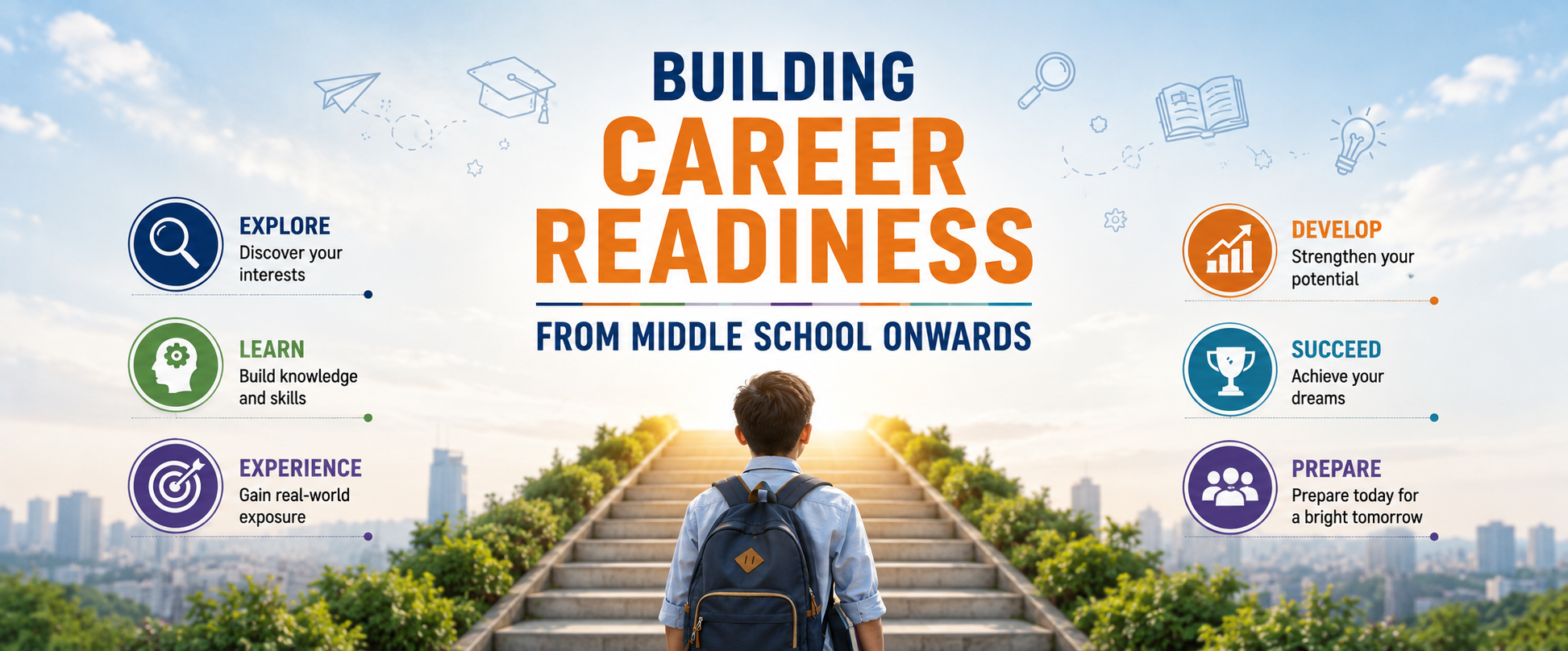
Career readiness is not about asking an eleven-year-old to pick a profession. It is about slowly building the muscles the curiosity, self-awareness, resilience, and decision-making that will let them choose well when the time actually comes. Let me walk you through how we think about this, stage by stage, and what any school or parent can start doing this week.
MIDDLE SCHOOL - THE AGE OF EXPLORATION NOT EXPECTATION
Middle school is often overlooked as a "holding period"- merely the bridge between childhood and the real decisions of high school. But in my experience, this is exactly backwards. Between the ages of eleven and fourteen, children are forming their first real opinions about what they are good at and what they enjoy. When this period is overlooked, children can begin defining themselves through self perception -one poor grade, a harsh comment or a casual remark rather than curiosity, exploration or discovering their true potential. Career readiness at this stage is 90 percent exposure and 10 percent reflection. We are not asking "What do you want to be?" We are asking "What did you enjoy about that activity, and why?"
THREE PILLARS WE BUILD ON :
1. Self-awareness before career awareness.
Before a student can meaningfully explore any profession, they need a working vocabulary for their own strengths, interests, and values. We use simple tools — interest mapping, reflection journals after group projects, and structured conversations after school events to help students notice patterns in what energizes them versus what drains them. One exercise we return to often, even with younger students, is a simplified SWOT ANALYSIS - a short, honest look at their strengths, weaknesses, opportunities, and threats. It sounds like a boardroom tool, but children take to it quickly once we translate it into plain language knowing what am I good at, understanding what challenges me, discovering opportunities around me and recognising what holds me back. Done once or twice a year, it becomes a quiet but powerful habit of self-reflection that carries all the way into their college and career decisions.
2. Exposure through doing, not just telling.
A career talk once a year does very little. What moves the needle is hands-on exposure: a shadow day with a working professional, a school-run "mini enterprise" where students design and sell something, a visit to a working farm, hospital, or newsroom. The learning happens in the doing, not in the listening.
3. Skill-building disguised as ordinary schoolwork.
Every group project is a lesson in collaboration. Every debate is a lesson in persuasion and research. Every failed science experiment is a lesson in resilience. We deliberately name these skills out loud to students -You just practiced negotiation; so they start to see their regular coursework as career preparation .
YEAR TO YEAR EVOLUTION
Grades 6–7: Broad exposure -CV building begins here.
Career days, guest speakers from varied fields, interest mapping tools, and simple projects that let students try different "hats" - organizer, presenter, builder, researcher.
Grade 8: Narrowing begins - exploration to direction.
Students start electing subjects or clubs based on genuine interest rather than convenience. This is a good year for a structured strengths assessment and a one-on-one conversation with a counselor.
Grades 9–10: Applied exploration - Creating your digital footprint. LinkedIn profile building ,Internships, job shadowing, subject-specific competitions, and honest conversations about the link between subject choices and future pathways.
Grades 11–12: Decision and preparation. Resume building, mock interviews, college and vocational counseling, and real-world projects tied to a chosen direction.
The pathway is not linear, and it should not be. A student who loved robotics in Grade 7 may discover a passion for design in Grade 10. Our job is not to lock students into an early choice but to keep giving them better information about themselves at every stage.
THE ROLE OF PARENTS AND TEACHERS
Parents often ask what they can do at home. My honest advice: talk about your own work, openly and without polish. Tell your child what you like about your job and what frustrates you. Take them along when you can. Let them see adults solving real problems, not just succeeding at them.
Teachers, similarly, do not need a separate "career period" to build readiness. A mathematics teacher who occasionally says "This is exactly what an engineer uses" is doing more for career readiness than a single annual assembly ever could.
PRACTICAL TAKEAWAYS
Start exposure early — by Grade 6, not Grade 10.
Prioritize hands-on experiences over lectures and slideshows.
Name skills explicitly when students demonstrate them in ordinary schoolwork.
Use a self discovery mapping tools once a year.
Involve parents into conversation .
See career direction as a journey leaving room to explore, adapt and change course.
Building career readiness is less like installing a single course into a curriculum and more like changing the climate of a school — the questions we ask students, the value we place on curiosity, and the patience we show as they figure themselves out. Do this well over six or seven years, and by the time a student sits for their final school exams, the question "What do I want to do next?" feels less like a cliff edge and more like the next natural step.
In conclusion I would say :
“Choose a job you love, and you will never have to work a day in your life.”